
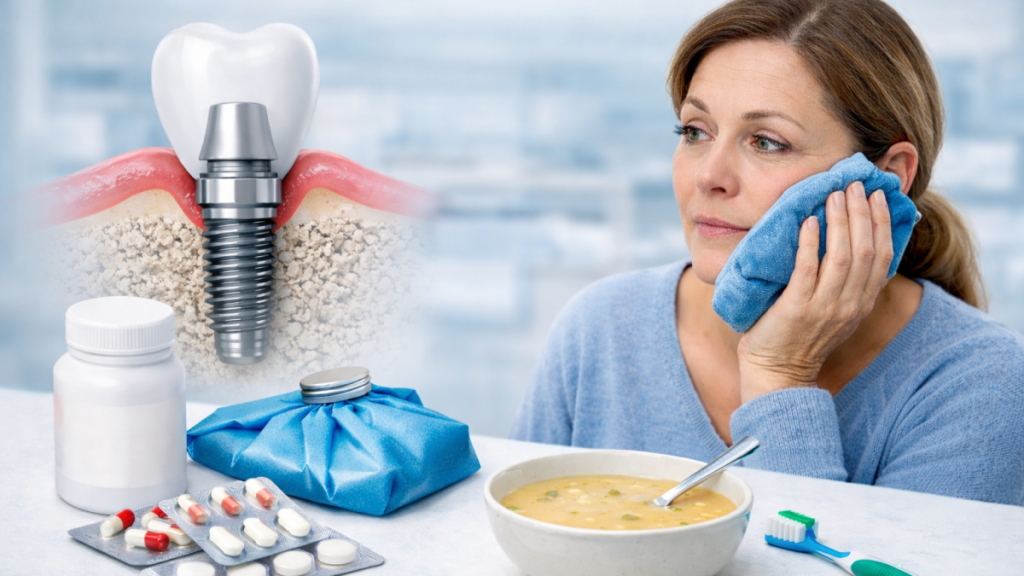
If you want to compare general guidelines for care during the healing process, you can review this external guide: dental implants aftercare (Bupa). The care after dental implants Key measures include applying cold compresses, following a soft diet, maintaining gentle but consistent hygiene with an ultra-soft toothbrush and mouthwash, avoiding strenuous physical activity, and not smoking to promote healing and prevent infection, while taking prescribed medications. It is essential not to touch the area, avoid vigorous rinsing or spitting initially, and use straws to allow the blood clot necessary for implant integration to form.
Before we go into detail, let me tell you something that almost no one explains well: most complications after an implant don't arise because "the implant was faulty," but rather from small, everyday actions in the first few days (rinsing vigorously, sucking on your teeth, smoking "just one," returning to the gym too soon, touching the wound with your tongue, etc.). This guide will provide you with a clear, phased plan outlining what you should do, what you should avoid, and when it's time to contact the clinic.
Important note about “straws”: it is common for many recommendations to indicate avoid Avoid using straws or suction initially, as the vacuum can interfere with the blood clot. If in doubt, follow your implantologist's personalized instructions (and, as a precaution, avoid suction for the first 24 hours).
Why the first few days matter more than you think
An implant doesn't magically "glue" to the bone. It requires a biological healing process followed by integration (osseointegration). In the initial phase, your body forms a clot and creates a stable environment for the tissue to heal and the implant to consolidate without infection or unnecessary movement. That's why so many instructions are repeated: don't rinse vigorously, don't spit forcefully, don't touch the area, don't strain, don't smoke.
It's also normal to notice the following in the first 24–72 hours:
- Inflammation (usually rises and then begins to fall).
- Discomforts that can be controlled with prescribed medication.
- Mild bleeding or slight discharge at the beginning.
What's relevant is the evolution: It should get better every day., no worse.
The first 24–48 hours: your goal is “calm and stability”
Think of these hours as a "protection mode." It's not about doing a thousand things, but about avoiding what disrupts the body's work.
Locally cold, but well done
Cold helps control inflammation and discomfort. Use it intermittently (for example, 10–15 minutes, rest, and repeat), always with a cloth between the cold and your skin to avoid burns.
Gauze and bleeding: what's normal and what's not
It's common for the healthcare professional to apply gauze and instruct you to bite down gently for a few minutes to promote bleeding. If there's only light bleeding, it can usually be controlled with gauze and rest. However, if the bleeding is heavy and doesn't stop, that's not normal, and you should consult a doctor.
No "try it and see how it is"“
Avoid:
- Touch the spot with your tongue or finger.
- Stretching the lip to "look".
- Feel the area.
These are innocent gestures that can irritate tissues and reopen bleeding.
Rinsing and spitting: the most important (and most ignored) part
During the first day, it's recommended to avoid rinsing vigorously or spitting, as this can destabilize the clot and delay healing. After 24 hours, if you are instructed to rinse (e.g., with salt water), do so gently. soft, without “aggressive gargling”.
Sleep with your head slightly elevated
Slightly elevating the torso can help with swelling and bleeding.
Post-implant care: hygiene without fear, but with method
This is where many people go wrong, either by overdoing it or by underdoing it:
- Some people don't clean their teeth "out of fear," which promotes plaque and bacteria.
- Others brush too hard and traumatize the wound.
The idea is simple: constant and gentle cleaning.
Day 0–1: Rest of the operated area
Many guidelines recommend that you don't brush the treated area on the first day and allow the tissues to rest. You can brush your other teeth normally, taking care not to touch the wound.
From 24 hours: ultra-soft brush without “rubbing”
Starting the next day, it's best to begin cleansing the area with a soft-bristled brush, using gentle movements. If you've been prescribed a mouthwash or gel (for example, chlorhexidine), use it as directed: not more often or for longer periods "just in case.".
Water flosser, floss, interdental brushes?
This is usually introduced when authorized by the professional, This is usually done after the initial healing period to avoid traumatizing the area. It is useful in the medium to long term, especially to prevent problems around the implant.
If you want to delve deeper into the topic of bacteria and plaque (which is the silent enemy of the implant), you'll be interested in reading about dental biofilm.
Nutrition: “soft diet” is not living on yogurt for three days
The bland diet has two objectives:
- Avoid traumatizing the area.
- Avoid foods that irritate or increase bleeding/inflammation.
What usually goes well in the first few days
- Cold or lukewarm foods: purees, yogurt, creams, very juicy omelet, soft fish, very cooked pasta.
- Chew on the opposite side if possible.
What to avoid at the beginning
- Very hot (may increase bleeding).
- Hard/crunchy (toast, nuts, rinds).
- Spicy or very acidic if that bothers you.
When will I be able to eat normally again?
There is no single "exact day" that everyone can achieve: it depends on whether it was a single implant, multiple implants, a graft, stitches, etc. The practical guide is:
- If there is no pain or pressure in the area when chewing, you can gradually increase the texture.
- If something bothers you, take a step back and check in review.
Rest, work and sport: realistic times, without heroics
The typical mistake is feeling fine the next day and going back to your usual routine (gym, lifting weights, intense exercise). This can increase bleeding and worsen inflammation.
As a general guideline, many guidelines recommend relative rest for 24–48 hours and avoiding physical exertion for at least the first few days (or longer if the procedure was complex).
Can I work the next day?
It depends on the type of work:
- Office/quiet activity: sometimes yes, if you're comfortable.
- Physical work: it's best to stop for a couple of days or as advised.
And what about playing sports?
- Walking gently: is usually acceptable soon.
- Gym, running, crossfit, intense cycling, weightlifting: it's best to wait and gradually reintroduce these activities once the inflammation has subsided and your dentist has given you the go-ahead.
Tobacco and alcohol: the “only one” that is expensive
If there's one factor that truly makes a difference to long-term success, it's tobacco. This isn't moralizing; it's biology. Smoking reduces blood flow and worsens wound healing, in addition to increasing the risk of infection and complications.
Scientific reviews have found a higher risk of implant failure in smokers compared to non-smokers.
Regarding alcohol: during immediate recovery it is recommended to avoid it (at least for the first 72 hours, or as instructed), because it can interfere with healing and medication.
Normal vs. worrying: warning signs
Don't put up with it out of pride. If any of these things apply to you, call and have them assess the situation.
Check if it appears:
- Heavy bleeding that does not stop.
- Intense pain that does not improve with prescribed medication.
- High fever (e.g., above 38–38.5°C) or clear worsening of general condition.
- Excessive inflammation or inflammation that worsens over time instead of improving.
- Persistent bad taste with suspected suppuration.
- Sensation of implant movement.
Phased plan: checklist for care after dental implants
To avoid any guesswork, here's a simple step-by-step plan. Always follow your clinic's instructions, especially if you're having a graft, breast lift, or multiple implants.
Phase 1: Day 0–2 (Protect)
- Intermittent local cold.
- Relative rest, head slightly elevated while sleeping.
- Avoid strong rinses, forceful spitting, and suction.
- Soft diet and lukewarm/cold temperature.
- Medication exactly as prescribed.
Phase 2: Day 3–7 (gentle cleanse and recover)
- Gentle hygiene around the area with a very soft brush.
- If you are prescribed rinses (salt water or mouthwash), do so gently and starting 24 hours after use.
- Avoid intense sports and exertion.
- Tobacco: the more, the worse. Ideally zero.
Phase 3: Week 2–4 (normalize without neglecting)
- Gradually return to a more normal diet, avoiding direct hard bites if discomfort persists.
- Introduce advanced hygiene tools only if indicated by the professional (interdental cleaner/irrigator).
- Check-ups: they are part of the treatment, not "an extra".
Phase 4: Maintenance (what makes the implant last)
The main difference between an implant that lasts for many years and one that develops complications usually lies in:
- Constant daily hygiene.
- Regular professional maintenance.
- Gum control (gingivitis/periodontitis) and plaque.
If you want more information about gums and maintenance, see the section on periodontics and, for general prevention, a dental cleaning and check-up periodic.
Typical mistakes to avoid
I'll explain them clearly because they're the ones that come up most often in consultations:
- “"Since it doesn't hurt, I can already resume normal life": the tissue is still healing.
- Aggressive brushing “to prevent infection”: increases irritation and can reopen the wound.
- Rinse vigorously or spit forcefully on the first day.
- Smoking “just one” because “that’s it”: tobacco is a real risk factor for complications and failure.
- Skipping checkups: many complications are detected early if you get a good checkup.
When to request a review even if it is “not urgent”
There are symptoms that are not always an emergency, but do warrant a check-up:
- Unusual sensitivity when biting that does not subside.
- The gum appears increasingly inflamed around the implant.
- Repeated bleeding when brushing in that area.
In these cases, a timely check-up prevents bigger problems.
If you're in the area and would like a professional to assess it, you can find out more about the treatment. dental implants either request an appointment from the page of contact.
Patient's opinion
“I was very worried about the post-operative period because I had heard stories of swelling and pain. In the end, by following the guidelines (cold, a soft diet, and gentle cleaning), it was all very manageable. What helped me most was understanding what was normal and what wasn't, and having my check-up confirm that it was healing well. Today I chew normally and I'm at ease because I know how to care for it.”
Frequent questions
How long does the pain last after a dental implant?
It's normal to experience discomfort for the first few days, which should gradually decrease. If the pain is intense, doesn't improve with the prescribed medication, or worsens, it's advisable to have it checked.
Is it normal to bleed after getting an implant?
Light bleeding in the first few hours can be normal. What is not normal is heavy bleeding that does not stop or persists in a worrying way.
When can I brush my teeth after an implant?
Many guidelines recommend not brushing the treated area on the first day and starting to gently clean around it after 24 hours, using a soft brush, following professional advice.
When can I rinse (with salt water or mouthwash)?
It is usually recommended to avoid rinsing on the first day and, if rinsing is scheduled, to start gently (without force) after 24 hours.
How much rest do I need after a dental implant?
As a general rule, relative rest for 24–48 hours is recommended, and physical exertion should be avoided for at least the first few days, adjusting it to the complexity of the case.
When can I smoke after an implant?
The safest thing for healing is not to smoke. Smoking is associated with poorer healing and a higher risk of complications and implant failure, so it should be avoided, especially at the beginning.
How do I know if the implant is getting infected or if there's a problem?
Signs that warrant a consultation: high fever, excessive or persistent swelling, intense pain that does not subside, persistent discharge/bad odor, heavy bleeding, or a feeling of movement.
Can you go to work the day after an implant?
It depends on the type of work. For jobs without physical exertion, some people can return to work soon if they feel well. For physically demanding jobs, it's usually recommended to rest for a few days.
If you want the implant to last for years, stick with this.
- The first two days are for protection: cold, relative rest, no sudden movements in the mouth.
- Hygiene is important, but gentle and consistent: first without touching the wound, then use a soft brush and follow their instructions.
- A truly soft and progressive diet, avoiding hard and hot foods at the beginning.
- Avoid tobacco (ideally zero): it is a serious risk factor for complications.
- If something gets worse instead of better, don't wait: a timely review usually simplifies everything.
Book your appointment today and wear a smile healthy, without discomfort and radiant to be proud of.
How can I book my appointment?
Booking your free appointment is very simple:
If you are in Seseña:
- Address: Calle Tirso de Molina 22, 45223 Seseña
- Phone: 669 956 658
If you are in El Barco de Ávila:
- Address: C. del Abanico, 10, Local 1, 05600 El Barco de Ávila, Ávila
- Phone: 606 886 468
Our customer service team will assist you with kindness and help you schedule your appointment at a time that best suits you.
We will wait for you!
